Train useful tasks
Stepping, turning, reaching and standing from a chair connect practice to everyday independence.
Concern guide 10 of 10
Healthy ageing is about keeping the abilities that make daily life yours: walking, reaching, carrying, balancing, resting and recovering with confidence.
Explore care options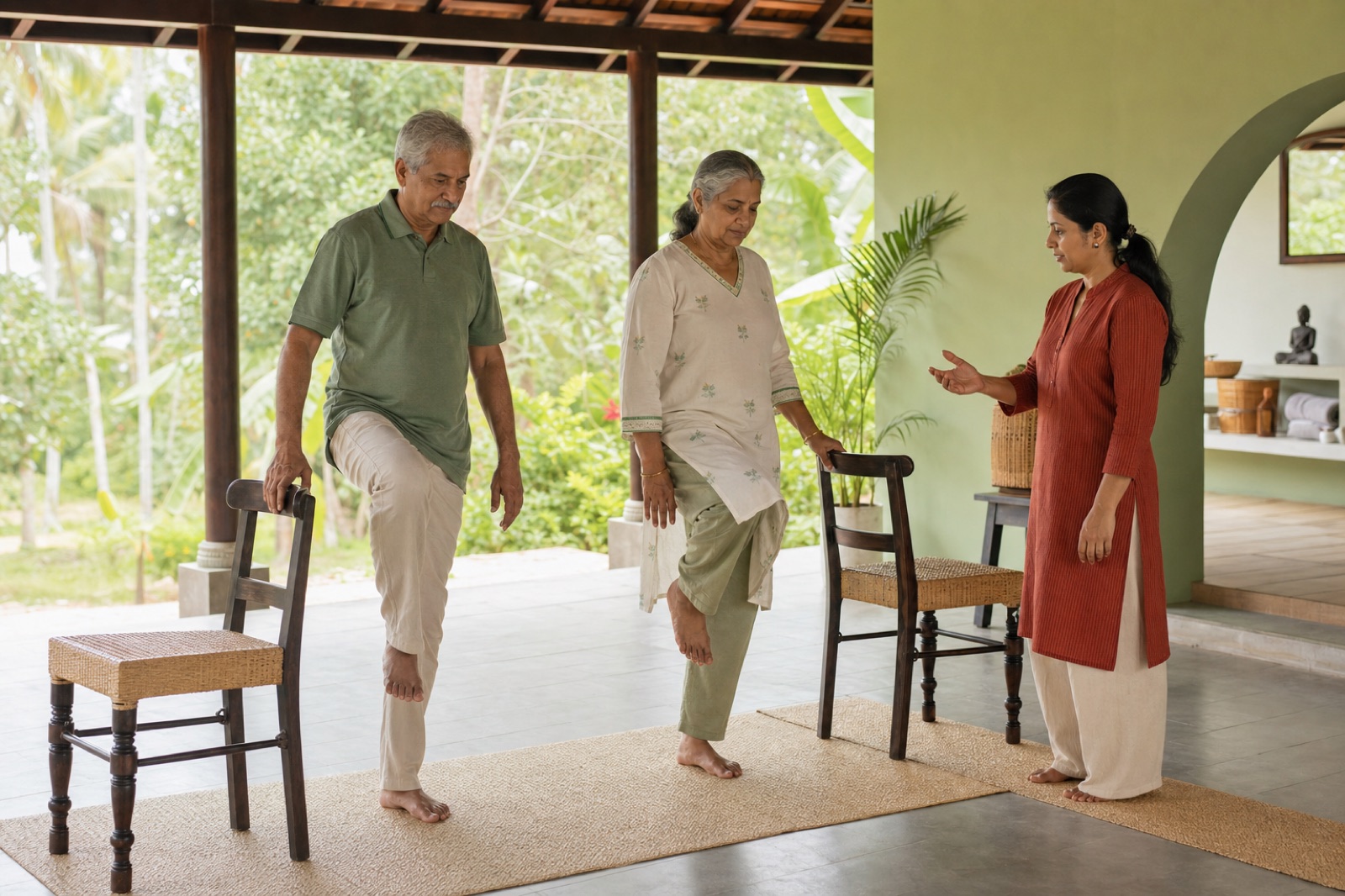
People often begin here when they notice
Understand the concern
Your starting point is shaped by current activity, joint history, health, balance and confidence. A programme can be fully chair-supported while still training useful strength, mobility and control.
Yoga can combine balance, mobility, leg strength, breathing and attention. We avoid extreme shapes and fast floor transitions, and we practise the real tasks behind independence: shifting weight, turning, stepping and getting up with control.
Massage or warm Ayurvedic bodywork can be included for comfort and recovery, while yoga builds the strength, balance and mobility used in everyday life.
When to see a doctor
Discuss new dizziness, fainting, chest pain, unexplained breathlessness, recent falls, rapid loss of strength or sudden confusion with a doctor. Bring your medication list and mention osteoporosis, glaucoma, replacements, neuropathy, stroke, heart conditions and balance problems.
If you are already receiving care, tell us about it so your sessions can be planned around it.
What can help
Stepping, turning, reaching and standing from a chair connect practice to everyday independence.
A chair, wall and close supervision let balance be challenged without making a fall the price of learning.
Sleep, adequate food and an appropriate activity dose matter as much as the exercise selection.
Care at Pranavam
Depending on what you are experiencing, one or more of these treatments may be helpful. We’ll talk through what feels suitable for you.
At Pranavam
One-to-one or small-group practice
Postures, breathing and guided stillness are adapted to your history, comfort and starting point, with a realistic sequence for home.
At Pranavam
Rhythmic warm-oil bodywork
A full-body Ayurvedic massage with warm oil and repeated strokes, selected for people who want unhurried, lower-intensity bodywork.
At Pranavam
Warm rice-and-herb bolus bodywork
Warm linen boluses prepared with rice, herbs and milk are applied in rhythmic strokes, giving a softer, padded feel than deep-pressure work.
Your first visit
Share how you feel, when it began, how it affects your day and any care you have already tried.
Dr. Athira will talk you through suitable options, what each one involves and how they may fit your needs.
Begin with a session or a simple plan, then adjust it based on how you respond and what feels realistic in daily life.
Questions people ask
There is no fixed age or flexibility requirement. The session can begin entirely with a chair and progress at your pace.
Balance practice builds control and confidence through stepping, turning, shifting weight and standing with support close by.
Ask when booking. A family member may help with history and confidence, while the clinical conversation and consent remain centred on the person receiving care.
Ready to talk?
Tell us what you’d like help with. We’ll guide you through the options.